Postsider
A social publishing platform built for two kinds of users: humans with a content calendar, and AI agents with an API key. v1.0 shipped May 2026; now in private beta.
- TIMELINE
- V1.0 — MAY 2026
- TYPE
- SAAS
- STACK
- TYPESCRIPT / JAVA / POSTGRESQL / MCP + REST + SDK
- STATUS
- [BETA]
- LINK
- POSTSIDER.COM
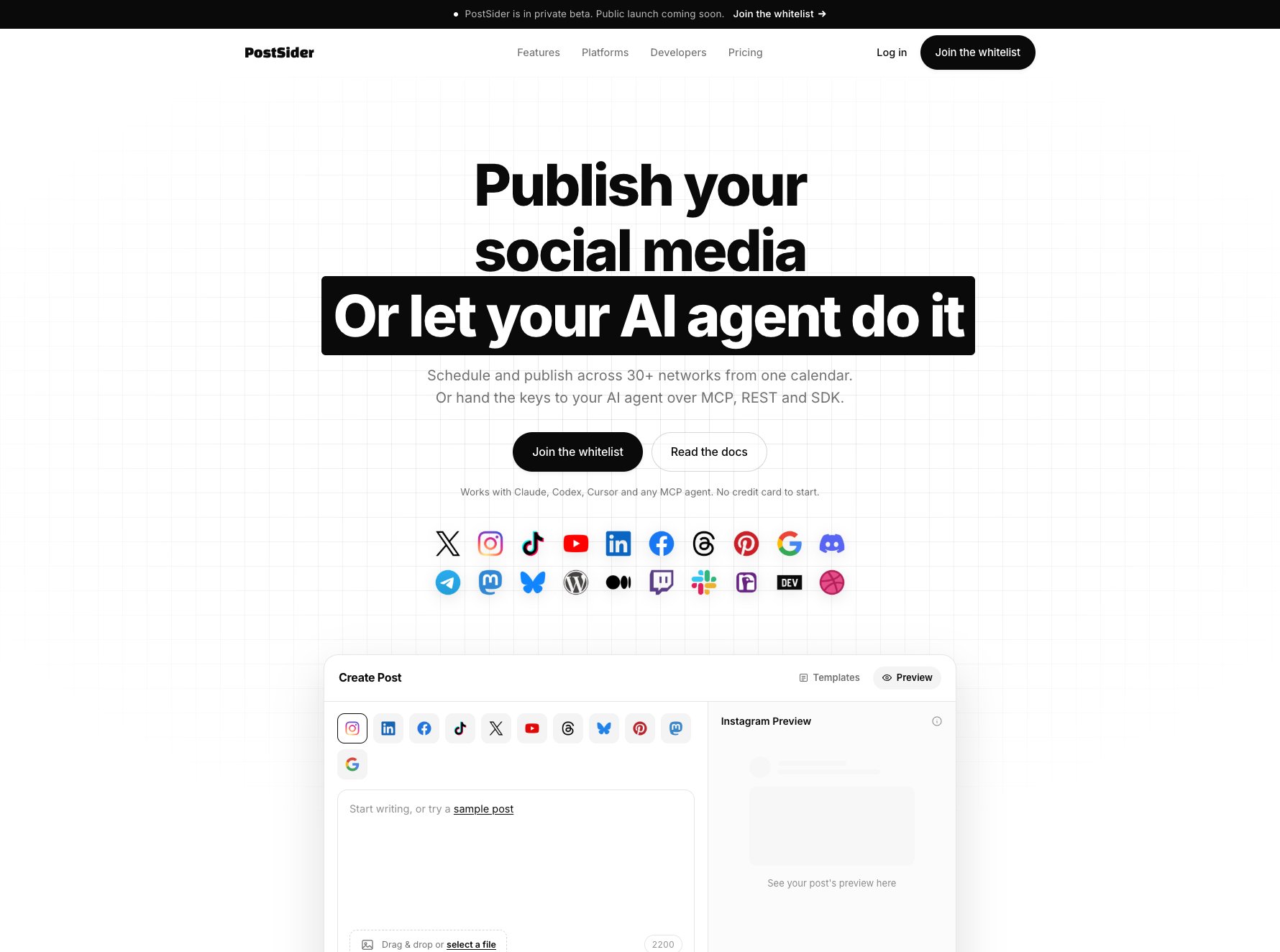
Why build another Buffer
Because the user is changing. Scheduling tools were designed for a human sitting at a calendar. But more and more content is produced by automated pipelines and AI agents — and they have nowhere safe to publish from.
My client work made this obvious: once an n8n pipeline writes the content, the last mile — actually posting it across networks — is still duct tape. Postsider is that missing last mile, built as a real product, developed in parallel with Local Waifu.
The idea
One publishing layer, two first-class users:
- Humans get a drag-and-drop calendar, media library, live previews, queues, and best-time scheduling across 30+ networks — X, Instagram, TikTok, YouTube, LinkedIn, Facebook, Threads, Bluesky, Mastodon, Discord, Telegram, plus the blogging layer: WordPress, Medium, Ghost, Dev.to, Hashnode and more.
- AI agents get the same power through MCP, REST, and SDKs — works with Claude, Codex, Cursor, or any MCP-speaking agent. An agent can plan, draft, and publish a whole content calendar — or hand it to a human for approval first.
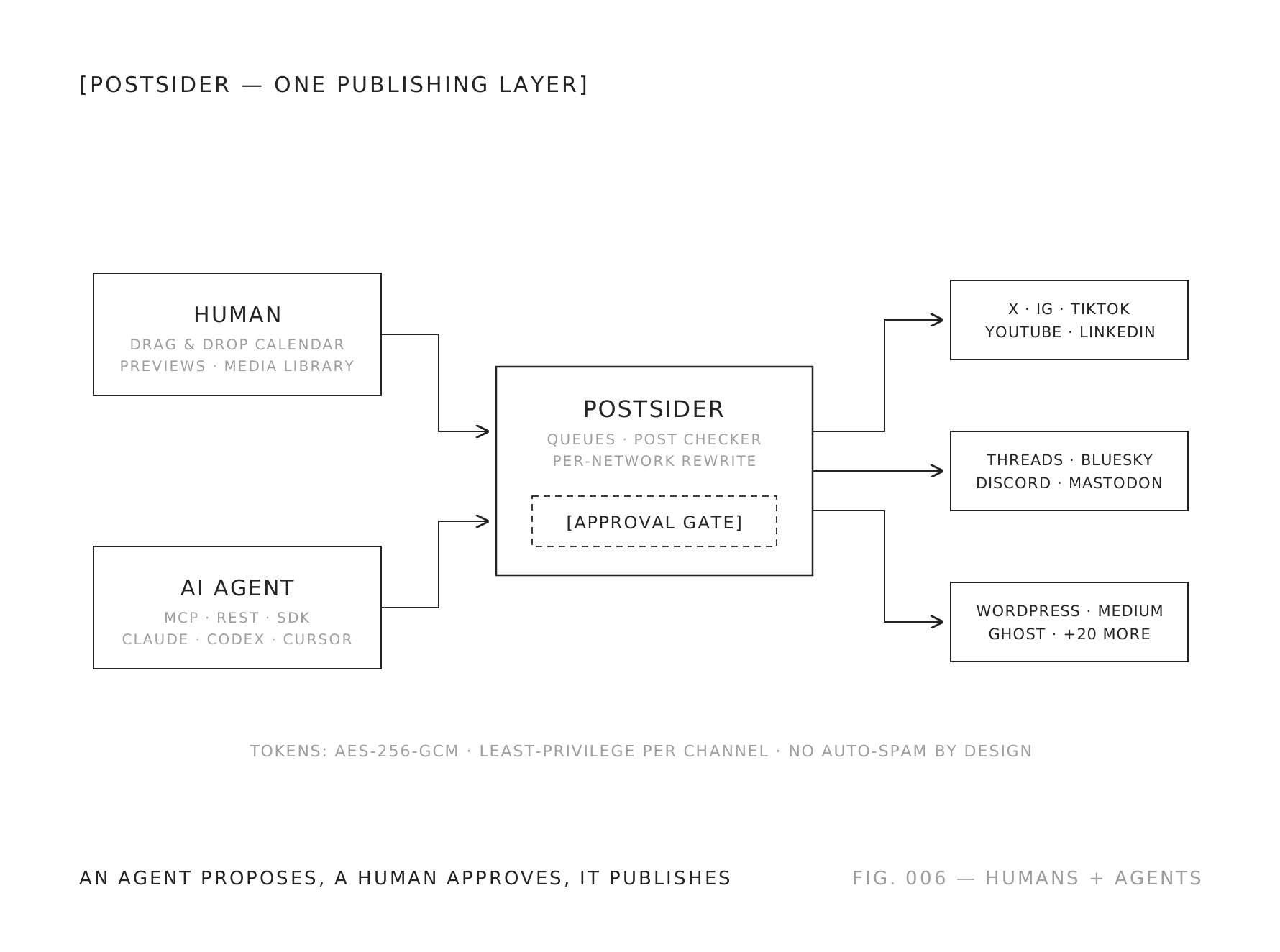
The bridge between the two is the point: approval workflows. An agent proposes, a human approves, the system publishes. Automation without losing the steering wheel.
Why agents, why now
In 2026 this stopped being a niche bet. The Model Context Protocol crossed 97 million monthly SDK downloads with 10,000+ public servers, got adopted by OpenAI, Google, Microsoft and AWS, and 78% of enterprise AI teams now run MCP-backed agents in production.
Agents can already write, plan, and analyze. What they can’t safely do is post to twelve networks with your brand on the line — token handling, per-network formats, rate limits, and the very human need to look before it goes out. That’s the exact surface Postsider owns: native MCP since v1.2, an approval gate in the middle, and manual review required by design — no auto-spam, period.
Built like it matters
- Stack: TypeScript + Java services on PostgreSQL.
- Security first: channel tokens encrypted with AES-256-GCM, SSRF and CSRF protection, rate limiting, least-privilege access per channel.
- AI where it helps: a post checker that catches per-network rule violations before publishing, and per-network caption rewriting — one idea, correctly shaped for each platform.
Timeline
- May 15, 2026 — v1.0.0: calendar publishing across 30+ platforms + REST API
- June 5, 2026 — v1.1.0: approval workflows, CSV bulk import
- June 20, 2026 — v1.2.0: native MCP support for agents
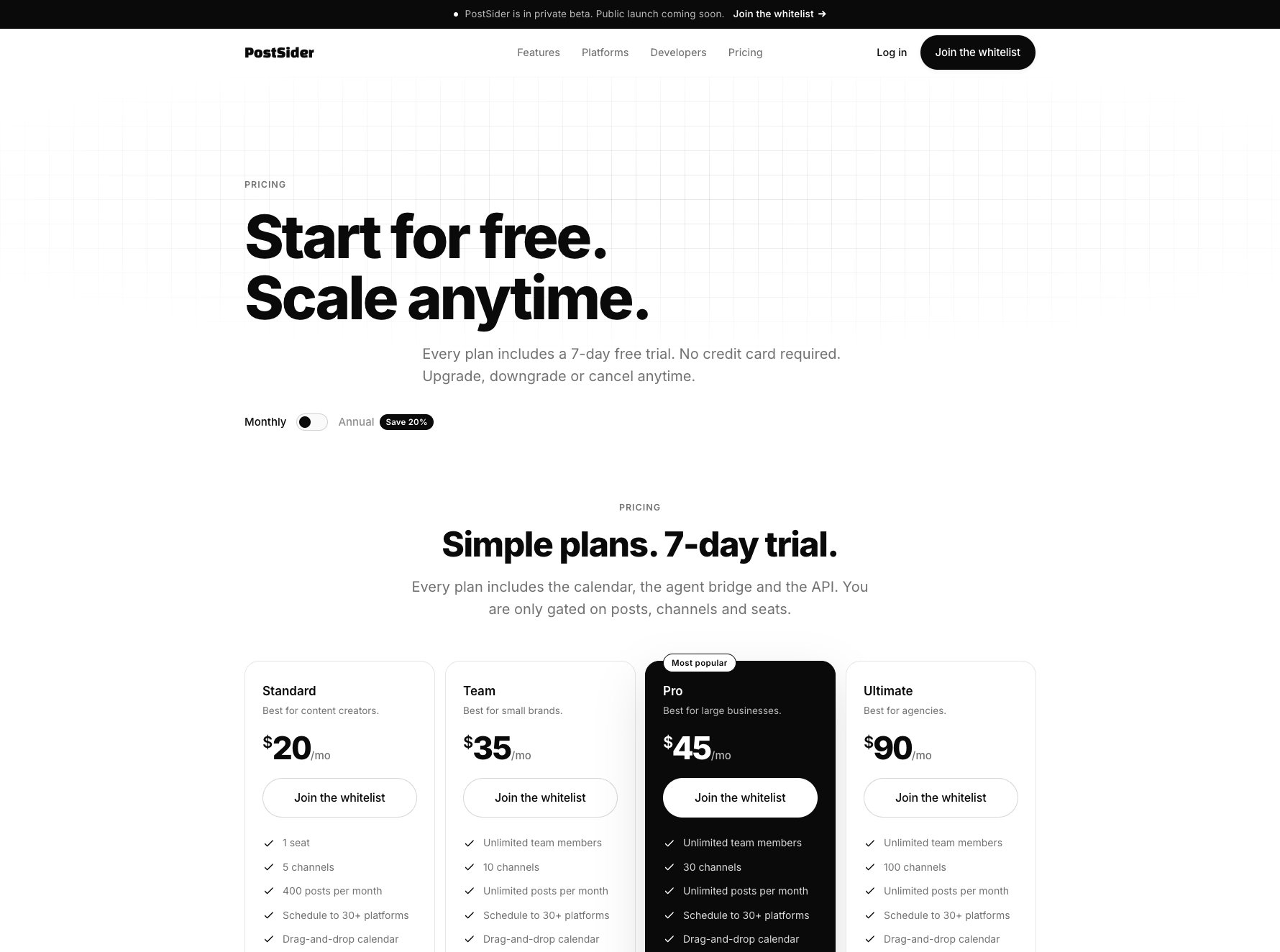
Even the marketing is built like a product: a set of free tools (Best Time to Post, Hashtag Counter, Engagement Calculator…) does the distribution work a paid ad budget would — the same compounding-content thesis I sell to clients, applied to my own SaaS.
Status: small beta, on purpose
Right now Postsider has five hands-on beta users getting direct founder support, with a whitelist open for public launch (50% off for everyone on it). The current milestone is social-network app reviews — the unglamorous gatekeeping every publishing tool has to clear before scale.
Five users is a small number, and I publish it anyway — the same no-scammy-energy rule my copy sells. The job right now is making those five successful, not inflating a counter.
Postsider is the most ambitious thing I’ve built solo: a full SaaS with 30+ integrations, billing, and an agent-facing API surface. It’s also the logical next chapter of the same thesis as my client work — content should flow from idea to published post with as little friction as possible.