WHAT MY ANALYTICS ACTUALLY SAY
Is SEO Dead in 2026? My Analytics Say Otherwise
Organic clicks really did collapse in 2026. My app still sold four copies overnight from Google. Here is what actually changed, and the test that decides whether a model cites your page.
“SEO is dead.” I have been hearing it for years, and lately louder than ever. AI answers on top of Google, nobody clicks the results, organic is a relic.
This morning I woke up to four emails from Dodo Payments. Four people had bought my app overnight while I was asleep.
I opened Umami to see where they came from. Google. Organic. No ads running, no campaign, nothing posted that day.
Someone typed a query, landed on a page, read it, and paid $20 for an offline AI companion. Four times, in one night, from the channel that supposedly died.
That is not a conference slide. It is four transactions. And the reason it happens is not that the doomers are wrong about the numbers. They are right about the numbers. They are wrong about what those numbers measure.
The short answer: the click died, the mechanism did not
SEO is not dead. Clicks per search collapsed, and that part is real and measurable. The chain underneath never moved: someone asks a question, something answers it, and that something has to pull the answer from a page that exists somewhere. Ten blue links became an AI Overview. Demand for a source went nowhere.
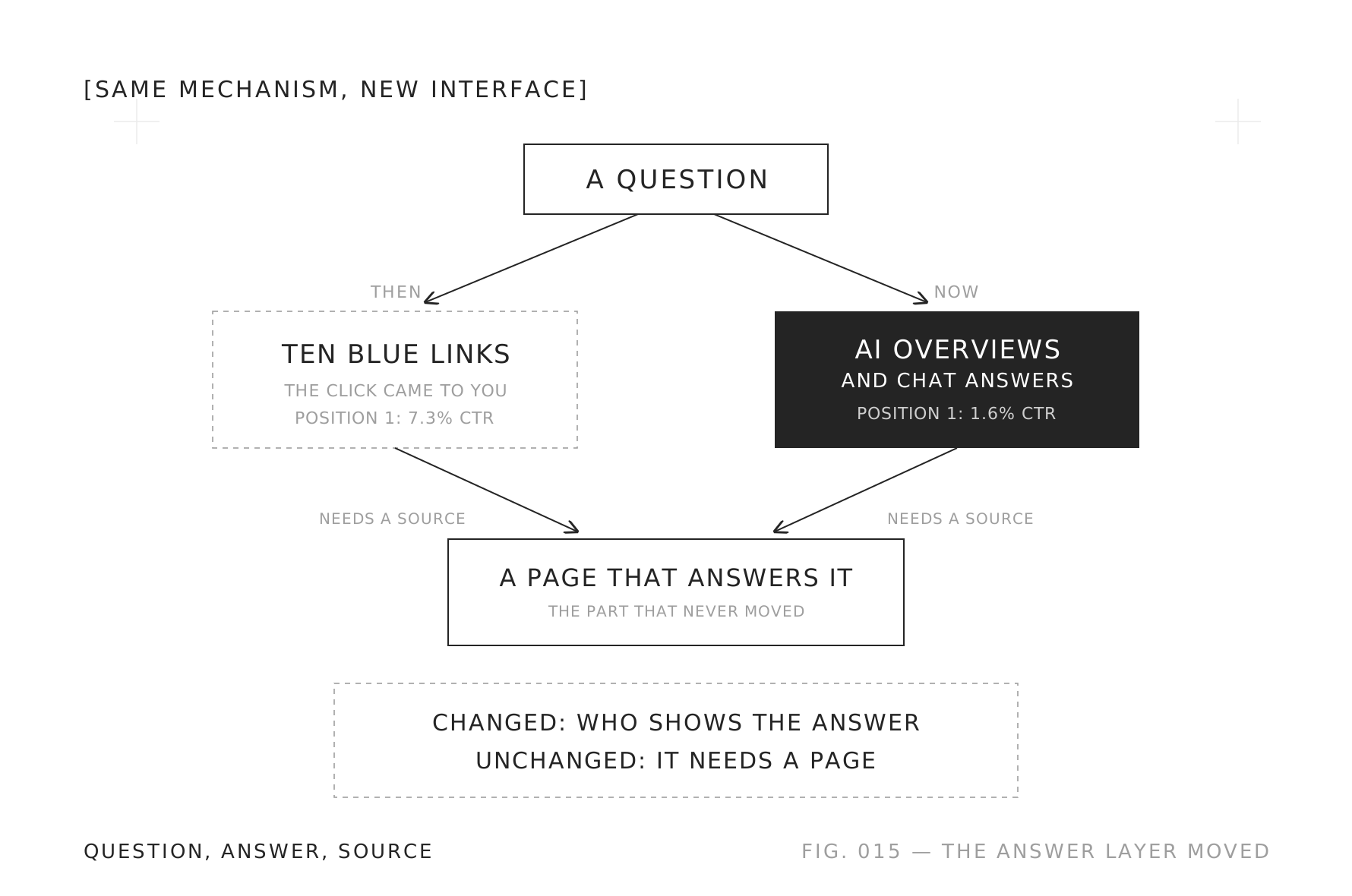
The interface changed. The plumbing did not. Every argument about the death of SEO is really an argument about one layer of that diagram, and it is the layer you never owned in the first place.
The click data is worse than the doomers claimed
Clicks fell hard, and I am not going to pretend otherwise to make a point. If your business plan assumed 2019 clickthrough rates, that plan is gone.
The numbers are ugly and they are public. Ahrefs measured a 58% lower clickthrough rate for the top-ranking page when an AI Overview is present, across 300,000 keywords, comparing December 2023 to December 2025. Position one on those queries went from a 7.3% clickthrough rate to 1.6%. Pew Research tracked the browsing of 900 US adults and found they clicked a search result in 8% of visits when an AI summary appeared, against 15% when it did not. They clicked a link inside the summary in about 1% of visits.
So when someone tells you traffic is down, believe them. Publishers built on informational search took the worst of it, and the panic is not manufactured.
Here is where the argument goes wrong. All of that measures clicks. Clicks were never the product. They were a proxy for the thing you actually wanted, which is a person who needed something and found you. That proxy broke. The need did not.
Ranking and getting cited have come apart
This is the part almost nobody in the “SEO is dead” genre mentions, and it is the most useful thing I know about search right now. Winning the keyword and getting quoted in the answer are no longer the same job.
Ahrefs looked at 863,000 keywords and 4 million AI Overview URLs and found that only 38% of the pages cited in AI Overviews rank in Google’s top 10 for that same query. In their July 2025 study, that figure was 76%. It halved in a year. Meanwhile seoClarity found that 97% of AI Overviews cite at least one source from the top 20, so being indexed and competitive still matters.
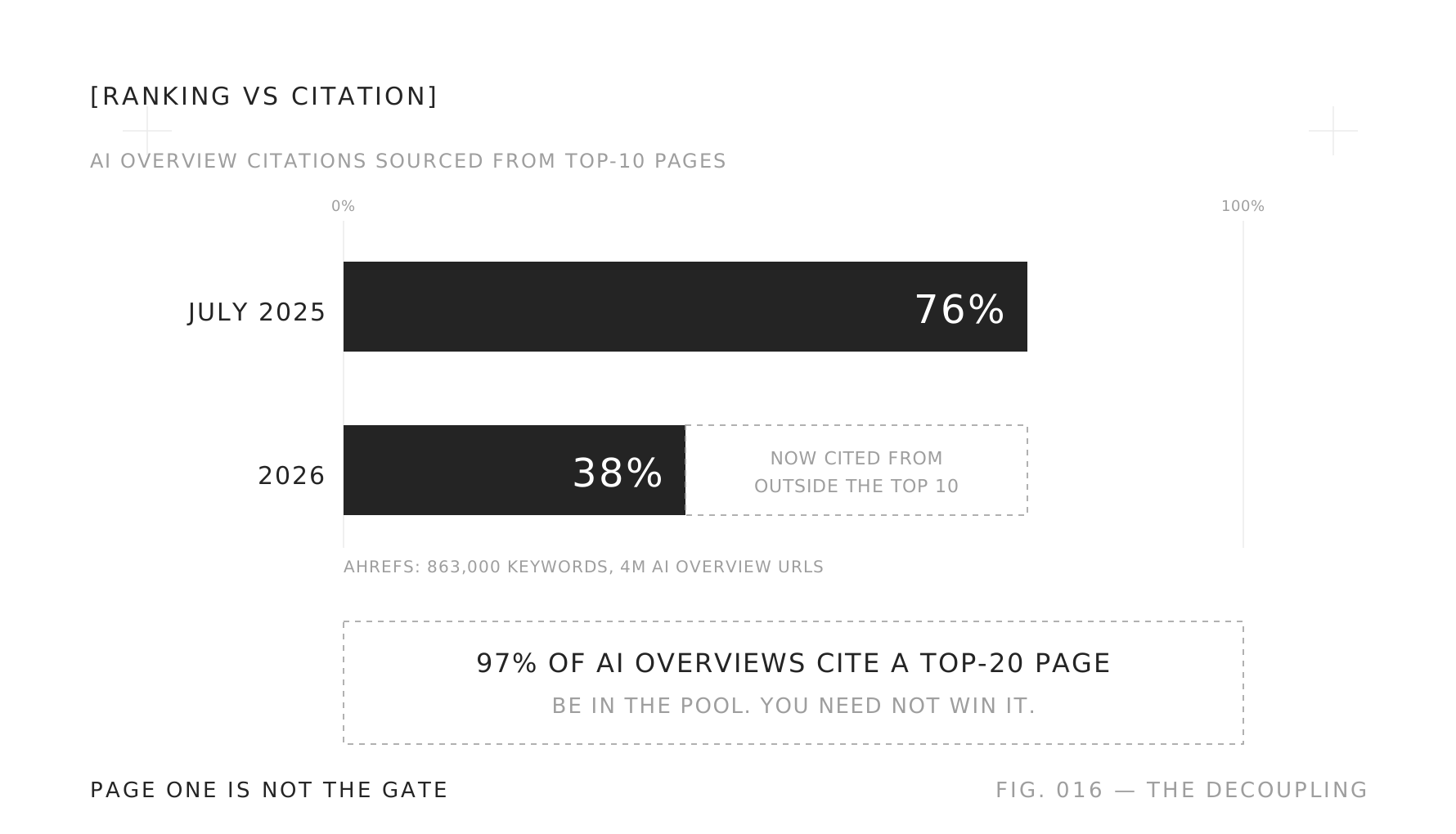
Read those two findings together and you get something close to a strategy. You have to be in the pool. You no longer have to win it. The model is not picking the page that beat everyone on backlinks, it is picking the page that answers this specific question best, and increasingly that page is sitting at position 14 with no domain authority to speak of.
For a solo operator that is not a funeral, it is a door. I am one person in Katowice selling a desktop app. I do not outrank the content teams in my category and I never will. Position 14 used to be worthless. Position 14 with the sharpest answer on the page is now a citation.
The clicks that survive are worth more than the ones you lost
Fewer visits, better visits. Semrush found that visitors arriving from AI search are worth about 4.4 times a traditional organic visitor on conversion. The reason is structural, not magical: the engine already handled the “what is this and why would I care” stage, so the person who clicks through has moved past it.
That matches what I saw this morning. Nobody buys a private offline AI companion at 3am while browsing casually. Whoever those four people were, they had already worked out what they wanted, and the page’s job was to close, not to teach. My analytics gave me the source and not the query, which is its own small lesson: I know Google sent them, I do not know what they asked. The page had to be good enough to survive a question I never saw.
The old funnel gave you a thousand tourists and a handful of buyers. The new one skips most of the tourists. If you are still grading the channel on session count, you will report a disaster while your revenue line stays flat.
Why a weird offline app gets found at all
I do not compete for “best AI companion.” That query belongs to sites with content budgets I could not match in a decade. I write for the narrow, awkward, specific questions people actually type when they are close to deciding.
Does it work without internet. Does anything leave my machine. Will it run on an M-series Mac with 16GB. Is it a subscription. What happens when I stop paying. Those questions have a right answer, my answer is first-hand because I built the thing, and there are not fifty pages competing to give it. That is the same logic I wrote about in SEO for boring niches, and it works even better now that the answer layer rewards precision over authority.
The Local Waifu case study is the whole argument in one product: private by design, one payment, no subscription. Every one of those attributes is a query someone types when they are sick of the alternative.
The test: would a model reach for your page?
Stop asking whether SEO is dead. Ask whether an answer engine has any reason to pull from your page. If the honest answer is no, then SEO is not what died.
Run a page through this. It takes two minutes and it is more useful than any ranking report:
- Does it answer one specific question in a paragraph a machine can lift verbatim? If your answer is spread across 800 words of warm-up, there is nothing to quote.
- Is there a number, a version, a price, or a measurement in it that only you have? Unique facts are the cheapest citation bait in existence.
- Is any of it first-hand? Something you built, broke, measured, or paid for. Models and humans both notice the difference.
- Would a knowledgeable person disagree with something on the page? A page with no position is a page with nothing worth quoting.
- Is it structured? Headings that read as questions, tables, a real FAQ. You are writing for a reader and a parser at once.
If a page fails all five, no algorithm update did that. That is a writing problem wearing an SEO costume. I go deeper on the workflow side in how the pipeline actually works and on the fear side in whether Google penalizes AI content, and the same five checks sit inside the editorial gate on every content automation project I run.
The question I would actually ask
Search did not stop working. It stopped being generous with attribution, which feels identical if traffic is the only thing you look at.
So here is my question, and it is not rhetorical. When did you last open your analytics and check where your customers really come from? Not impressions. Not average position. Customers, the ones who paid you.
I checked mine over coffee this morning and the answer was Google, four times, while I slept. If you check yours and cannot tell, that is worth a conversation before you write off a channel that might already be working.
FAQ
- Is SEO dead in 2026?
- No, but the click economy around it shrank hard. Clicks per search fell sharply once AI Overviews rolled out, so measuring SEO purely by sessions makes it look dead. The underlying chain still runs: people ask questions, answer engines respond, and those engines need source pages. Optimizing to be that source is still SEO, just judged on citations and conversions instead of raw traffic.
- Do AI Overviews stop people from clicking?
- They cut clicks a lot. Ahrefs found a 58% lower clickthrough rate for the top-ranking page when an AI Overview appears, and Pew Research found users clicked a search result in 8% of visits with an AI summary versus 15% without. They also click the links inside the summary rarely, in about 1% of visits. Fewer clicks, not zero clicks.
- Do I need to rank in the top 10 to get cited by AI Overviews?
- Not anymore. Ahrefs found only 38% of AI Overview citations come from pages ranking in the top 10 for that query, down from 76% in mid-2025. seoClarity found 97% of AI Overviews cite at least one source from the top 20, so you still need to be indexed and competitive. You no longer need to win the keyword outright to get quoted.
- Is traffic from AI search worth less than Google organic?
- The opposite, per volume. Semrush found visitors arriving from AI search convert at roughly 4.4 times the value of traditional organic visitors, because the engine already handled the basic research and the person clicks through to verify or to buy. You get fewer visits and each one sits closer to a decision.